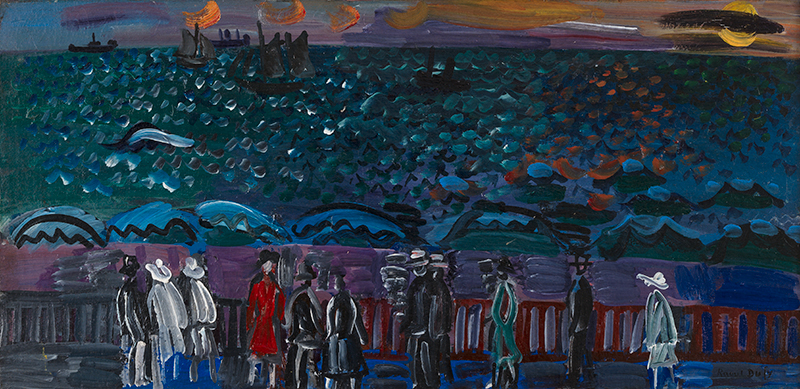
Promenade au bord de la mer (Saint-Adresse), c. 1924
Oil on canvas, signed lower right.
30 x 61 cm
Provenance :
Modern Paintings Sale, Drouot, Bellier, Paris, 6 June 1929, lot 29, illustrated in the sale catalogue
Sotheby Parke Bernet, New York, 5 May 1973, lot 32A, illustrated in colour in the sale catalogue
Drouot, Thierry de Maigret, Paris, 6 June 2019, lot 124
Private collection, France
Exhibitions :
Dufy – Rouault – Vlaminck, Kunsthalle, Basel, Switzerland, May–June 1938, no. 65, illustrated p. 33 of the catalogue
Literature :
Maurice Lafaille, Raoul Dufy, Catalogue de l’oeuvre peint, Vol. II, Editions Motte, Genève, 1973, reproduced p. 232, no. 698
Related works :
To be compared with two works held in the collection of the
Musée des Beaux-Arts de Nancy:
Vue de la Terrasse de Sainte-Adresse, soleil couchant or Sainte-Adresse, Night, circa 1925 (oil on canvas, 38.5 × 46 cm), no. 65.2.29
Vue de la Terrasse de Sainte-Adresse or Sainte-Adresse, Day, circa 1925 (oil on canvas, 38.5 × 46 cm), no. 65.2.30
Certificate issued by Mrs Fanny Guillon-Laffaille.
The sun has almost merged with the sea at the moment when Dufy captures the elegant strollers along the seafront boulevard. It is no longer time for bathing, yet it is nearly time for dinner, and so one strolls along the beach, waiting for the moment to take a seat at the table.
The luminous blue that dominates the afternoon gives way to a seascape with expressive, dissonant tonalities. Over a dark green ground, the sea is overlaid with heterogeneous touches of blue, violet, white, black and, here and there, orange, lending it a restless, almost unsettling quality. Colour frees itself from any realistic or descriptive function and becomes fully expressive.
In the language that characterises him, Dufy also punctuates his composition with signs. These take form here directly through the brushstroke—nervous and incisive—which juxtaposes touches that differ in shape, orientation and thickness, intensifying a palpable tension that runs across the surface of the painting.
Though Dufy was certainly capable of decorative effects, he was above all a painter, as works of such pictorial force clearly attest.
The seafront boulevard leading to the beach at Sainte-Adresse, in his native city of Le Havre, regularly inspired the artist.
From a Belle Époque promenade of decidedly mondain character, where the elegant bourgeoisie exchanged greetings, it gradually became, after the end of the First World War, a more open space, accompanying the democratisation of leisure and the evolution of seaside practices of which the painter was a witness. In such places, the artist began to observe the coexistence of two worlds that had previously been entirely separate. The advent of this social permeability is revealing of a new state of the world and, quite possibly, of a form of modernity.
Somewhat later, overlooking the bay of Sainte-Adresse, the painter sought to encompass everything within a single vision: strollers, bathers, regattas… he even added sirens, affirming the fully balneary character of the resort, which had by then become more popular in nature.
The work presented here, dated between 1924 and 1925, offers a crepuscular vision—certainly reduced in scale yet panoramic—of the strollers along the parapet. The use of this markedly elongated format is not uncommon and proved particularly appealing to the artist when painting seascapes.
Two works executed at the same period, now in the collection of the Musée des Beaux-Arts de Nancy, together with a third canvas, likewise dated around 1925 and held at the MuMa in Le Havre, complete our view of Dufy painting this emblematic site of his native city.
The two paintings in Nancy, of identical format, form an almost diptych and have accordingly been renamed over time to allow them to respond to one another in their museographic presentation: Sainte-Adresse – Day and Sainte-Adresse – Night.
The viewpoint is identical to that of our painting, although differences in treatment result in a markedly distinct final effect.
The third work is of a more surprising facture, with two-thirds of the surface occupied by an immobile blue, laid down in two closely related tones, barely separated by the horizon line dividing sea and sky.
Placing inspiration and instinct at the forefront of his creative impulses, Dufy never confines himself within a system. He demonstrates here his great technical mastery: the range of tools at his disposal enables him to convey a personal vision of the moment—his own sensibility.
“Painting is the creation of an image that is not the natural appearance of something, but that nonetheless possesses the force of reality; this has been expressed in another way as nature seen through a temperament. Only painting can produce such an image, which eludes literature, poetry and music.”
Everywhere the painter perceived a spectacle, yet he did not merely paint it: he narrated it, in a language so personal and precise that it attains a universal dimension.